5 Signs Your Crawl Space Encapsulation Is Failing
When "Done" Doesn't Mean Done Right
I'm standing in a crawl space in Boody, Illinois that was already encapsulated. Someone already did the work. The homeowner already paid for it.
So why is there mold growing throughout the floor framing? Why is the HVAC plenum covered in rust? Why is there standing water on top of the vapor barrier?
Because "encapsulated" doesn't automatically mean it was done right.
This homeowner is dealing with health reactions from mold exposure. Her heating and cooling costs are through the roof. And now she's paying to have the whole thing redone—because the first crew cut corners on materials and skipped critical steps.
If you've had crawl space work done, here are five signs that it might be failing. And what those signs actually mean for your home.
The Job That Brought Us to Boody
This homeowner called us because something wasn't right. She'd had encapsulation work done, but her house didn't feel better. If anything, things seemed worse.
When we got down there, we could see why.
The previous crew did spray foam the rim joist—that part was done correctly. But almost everything else had problems.
They used thin 6-mil plastic instead of proper reinforced vapor barrier. It wasn't mechanically attached to the walls, so it's already falling down around the crawl space entrance. The piers weren't wrapped. And the biggest issue: no dehumidifier.
The result? Mold growing in the joist pockets. Mold on the subfloor. Mold on the main beam. Rust eating through the HVAC plenum from constant condensation. Standing water pooling on top of the vapor barrier.
And a homeowner who's literally getting sick from the air in her own house—because about 50% of indoor air comes from the crawl space.
Now we're pulling all that inadequate material out and doing it right. But she shouldn't have had to pay twice.
Sign #1: You Can See Mold Growing
This is the most obvious sign that something's wrong with your encapsulation.
In this Boody crawl space, we found mold growing in the joist pockets where the floor joists meet the foundation wall. Mold on the subfloor above us. Mold on the main beam. Everywhere we looked, there was biological growth that shouldn't be there.
Here's why that matters: mold grows when there's moisture and no air circulation. A properly encapsulated crawl space controls moisture and maintains low humidity. If mold is growing after encapsulation, it means the system isn't working.
And remember—about 50% of the air you breathe upstairs is coming from your crawl space. When there's mold down there, you're breathing it in your living room, your bedroom, your kitchen.
A proper encapsulation with the right materials and a dehumidifier creates an environment where mold can't grow. If you're seeing mold after the work was supposedly "done," the job wasn't finished correctly.
Sign #2: Your HVAC Ducts Are Rusting
Look at the bottom of the HVAC plenum in this crawl space. See all that rust?
That's not normal wear and tear. That's active corrosion from constant condensation.
Here's what's happening: when your air conditioner kicks on, it sends cold air through that metal ductwork. If the air surrounding the duct is humid—like it is in this improperly sealed crawl space—that cold surface causes condensation. Just like a cold glass of water on a humid day.
That moisture sits on the metal, causes rust, and eventually eats holes right through your ductwork.
Now this homeowner is losing a huge percentage of her heated and cooled air directly into the crawl space instead of into her house. She's paying to condition a space she doesn't even use, while her actual living areas stay uncomfortable.
A dehumidifier prevents this. It keeps the crawl space humidity low enough that condensation can't form on cold surfaces. Without one, your HVAC system is fighting a losing battle—and slowly destroying itself in the process.
Sign #3: There's Standing Water on the Vapor Barrier
In a properly encapsulated crawl space, you shouldn't see standing water sitting on top of the vapor barrier.
But in this Boody job, there it is—pooling in several spots.
That water is getting in somehow. Either through unsealed edges where the barrier meets the wall, through gaps around piers that weren't wrapped, or because the barrier itself isn't thick enough to handle ground moisture pushing up from below.
The crew that did this work used 6-mil plastic. That's what you'd use to cover furniture when you're painting. It's not rated for crawl space encapsulation.
We use 20-mil fiberglass-reinforced vapor barrier. It's thick, tear-resistant, and actually designed for this application. We mechanically fasten it to the foundation walls with special fasteners, then seal all the seams and edges so moisture can't sneak in behind it.
If you're seeing water on your vapor barrier, it means moisture is still getting into your crawl space. And if moisture is getting in with no dehumidifier to remove it, you've got all the ingredients for mold growth and structural problems.
Sign #4: The Vapor Barrier Is Falling Down or Coming Loose
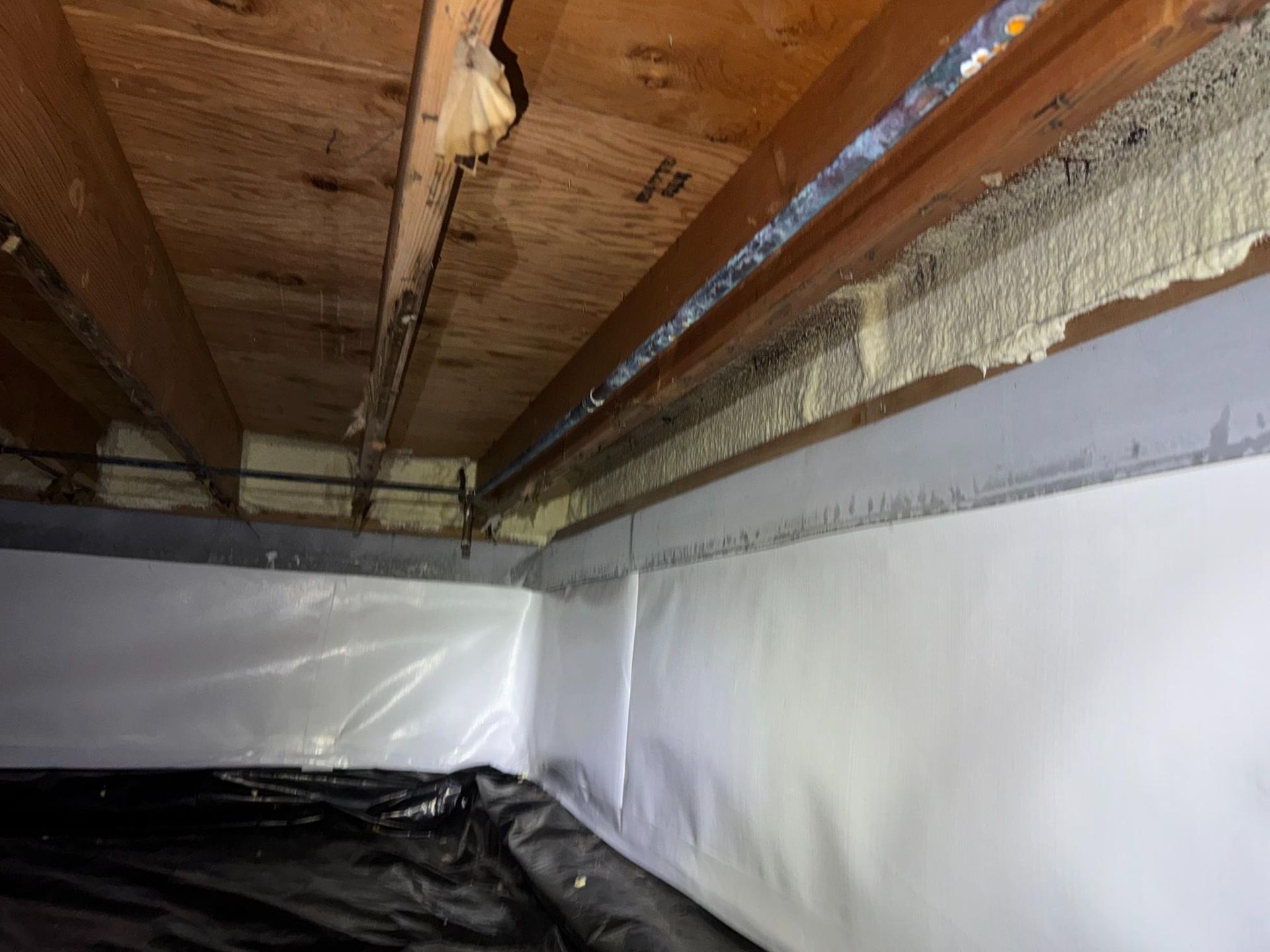
Walk into this crawl space and the first thing you see is vapor barrier sagging and falling away from the walls around the entrance.
That's because it was never properly attached in the first place.
Some crews just lay the plastic on the ground, maybe tape it to the walls if you're lucky, and call it done. But tape doesn't last in a crawl space environment. It loses adhesion, gets wet, peels away. Then you've got gaps where humid outside air is flowing right in behind your "sealed" system.
Proper installation means mechanically fastening the barrier to the foundation walls. We're talking actual fasteners driven into the concrete, not tape or glue. Then we seal those attachment points and all the seams to create a true moisture barrier.
When vapor barrier is falling down, it's not doing its job. Moisture is getting around it, behind it, and into your crawl space. All that money you spent on encapsulation is literally sagging away from the walls.
If your barrier isn't tight and secure against the foundation, it's failing.
Sign #5: There's No Dehumidifier (Or It's Not Running)
This is the biggest problem we found in Boody. Everything else could be fixed, worked around, or patched. But this one? This is what's causing most of the damage.
There's no dehumidifier.
Here's what people don't understand: sealing up a crawl space without dehumidification is like putting a lid on a pot of boiling water. You're not solving the moisture problem—you're just trapping it.
When you encapsulate, you're creating a sealed environment. Any moisture that gets in through the ground, through tiny gaps, through building materials releasing water vapor—it all stays in there. With nowhere to go, the humidity climbs higher and higher.
That's why this crawl space has mold everywhere. That's why there's condensation rusting out the HVAC ducts. That's why the homeowner is dealing with health issues.
A dehumidifier doesn't just help—it's the whole point of sealing the space. It actively removes moisture from the air and maintains proper humidity levels. Without it, you've just created an expensive terrarium under your house.
If you had encapsulation done and there's no dehumidifier, or if there is one but it's not running, your system is incomplete. It's like buying a car without an engine. It might look right, but it's not actually doing what it's supposed to do.
Book A Free Inspection Now
Your crawl space problems aren't going to fix themselves. But they are fixable. Let's get it done — the right way, permanently.
Or call us directly (217) 863-9559
Get a Second Opinion
If you're seeing these warning signs in your Central Illinois crawl space, we can help.
We'll come out and do a thorough inspection—show you exactly what's happening and why. We'll document everything with photos and video, just like we did in Boody. And we'll give you an honest assessment of what actually needs to be fixed.
No pressure. No sales pitch. Just Chris or me explaining what we're seeing and what we'd recommend.
Call us or send a message. We're right here in Mahomet, and we're ready to help.