
Bloomington, IL · Central Illinois
Crawl Space Encapsulation in Bloomington, IL
You noticed something. A smell that wasn't there before. A floor that gives a little in one spot. An energy bill that keeps creeping up. Maybe the pest control guy said something during his last visit that stuck with you. If something feels off and you haven't been able to pin it down, there's a good chance it's coming from below:
- A smell that wasn't there before
- A floor that gives a little in one spot
- An energy bill that keeps creeping up
Free assessment. You'll talk to Jeff or Chris directly — not a call center.
Worth checking
It's Probably Coming From Below
That dump smell
Floors that give
Sticky air
That's the right instinct. Here's what's actually happening.
Here's something worth knowing: roughly 50% of the air you breathe in your home comes up from the crawl space. If that space is damp, moldy, and full of stale ground air, that's what's moving through your floors and into your living space every day — the musty smell in the back bedroom, waking up congested, allergy symptoms with no obvious source.
One of our customers recently mentioned she'd been able to reduce her antihistamines after we finished her encapsulation. That's not unusual. In Bloomington, that environment is working against your home in ways specific to this soil, this climate, and how these homes were built.


Why Bloomington Homes Have Crawl Space Problems
Bloomington, IL sits on Drummer silty clay loam- the Illinois state soil. It's what makes McLean County farmland so productive. It holds moisture exceptionally well.
Drummer Silty Clay Loam
It's what makes McLean County farmland so productive — it holds moisture exceptionally well. Under a field, that's a good thing. Under your house, it works against you, staying saturated for days after a rain and pushing moisture upward continuously.
The Dew Point Window
When July and August dew points climb above 65°F, humid outdoor air condenses on wood, insulation, and ductwork the moment it hits a cooler crawl space. Mold can establish within 48 hours once conditions are right.
Radon Risk Zone
Central Illinois sits in a moderate-to-high radon risk zone. Encapsulation and radon mitigation need to be planned together from the start — it's not something you can easily retrofit later.
Mahomet-based, local crew
Not a Call Center. You Get Us.
My Guys Home Services is a crawl space encapsulation contractor based in Mahomet, IL, serving Bloomington-Normal and Central Illinois.
When you reach out, you're talking to Jeff or Chris — not a scheduler. We sit down with you first, do a full walkthrough that starts outside, and explain every recommendation before we ask you to decide anything. Multi-day jobs mean we're there every day until it's done.
Free assessment. Same-day written proposal.
What's underfoot in Bloomington
Why Spring is When Most Homeowners Notice
Snowmelt, heavy April rain, and still-cold soil create the most moisture pressure of the year. If you're smelling something in May that wasn't there in February, that's why — Drummer soil stays saturated for days after a rain and keeps pushing moisture upward the whole time.
Your crawl space floor sits directly on top of that. It's not a one-time event — it's a seasonal pattern that repeats every year this region has clay soil and a humid continental climate.
Then add:
Spring snowmelt
Heavy April rain
Summer dew points
...and your crawl space sits at the center of all three, every year.
How the houses got built
Bloomington's Older Homes and Vented Crawl Spaces
West of Veterans Parkway, Franklin Park & the East Side
The Idea Made Sense — On Paper
Most of the Champaign crawl spaces we get into were built between the 1950s and 1970s. The builders did what was standard at the time — vented crawl spaces, designed to breathe. We now know that what they were breathing in was the problem.
If Your Home Is From That Era
The Insulation Has Been Soaking It Up for Decades
The fiberglass insulation between your floor joists has been absorbing moisture for decades. It sags. It holds mold. In many cases it's doing more harm than good at this point. This isn't a sign something went wrong with your house — it's a sign the original design wasn't built for this climate.
The Surprising Part
Vents Help on About Six Days a Year
Crawl space vents are only useful on a low-humidity, high-wind day. In central Illinois, that's about six days a year. The other 359 days, open vents let in exactly what you're trying to keep out.
Most of Normal's housing stock was built in the postwar boom of the 1950s and 1960s
- vented crawl spaces
- minimal vapor barriers
- fiberglass insulation
That has been absorbing and releasing moisture for sixty years.
In many of these homes that insulation is now trapping moisture against the subfloor rather than protecting it.
Where your home sits in Normal matters. What era it was built in matters. That's what we're looking at when we come to your house — not a generic crawl space problem, but your specific one.
What goes in
How the Seal Comes Together Under a Central Illinois Crawl Space
Ground moisture
Outside air
Humidity
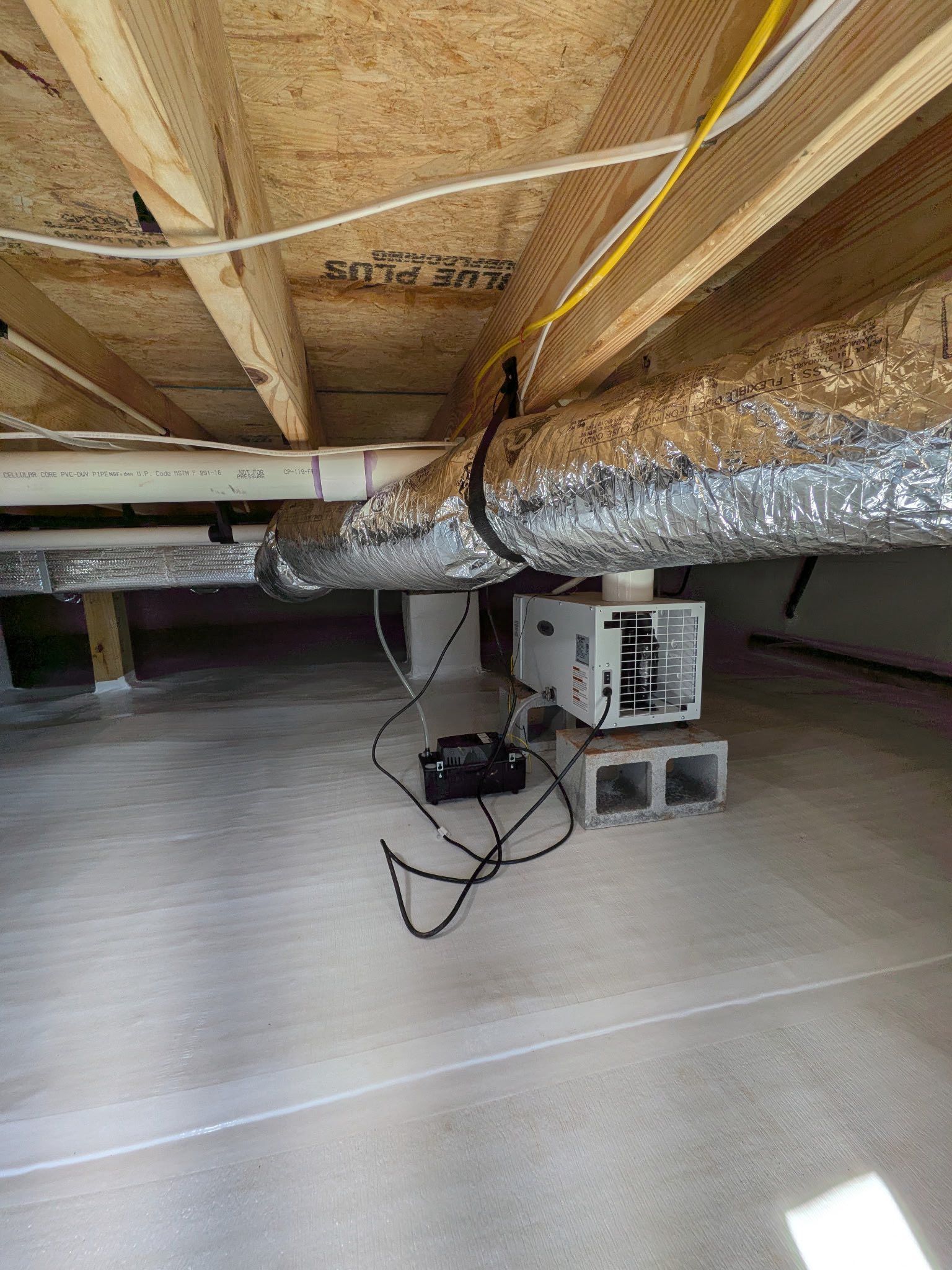
Encapsulation seals the environment beneath your home so that ground moisture, outside air, and humidity stop having free access to your floor system and the air above it.
01
Rim Joists & Vents Sealed
If there's active water coming in, we address drainage first — a liner over a water problem is a cover-up, not an encapsulation. Then every vent and every gap where outside air sneaks in gets closed with spray foam, including the rim joists, where most of the air leakage happens.
02
Heavy-Duty Vapor Barrier
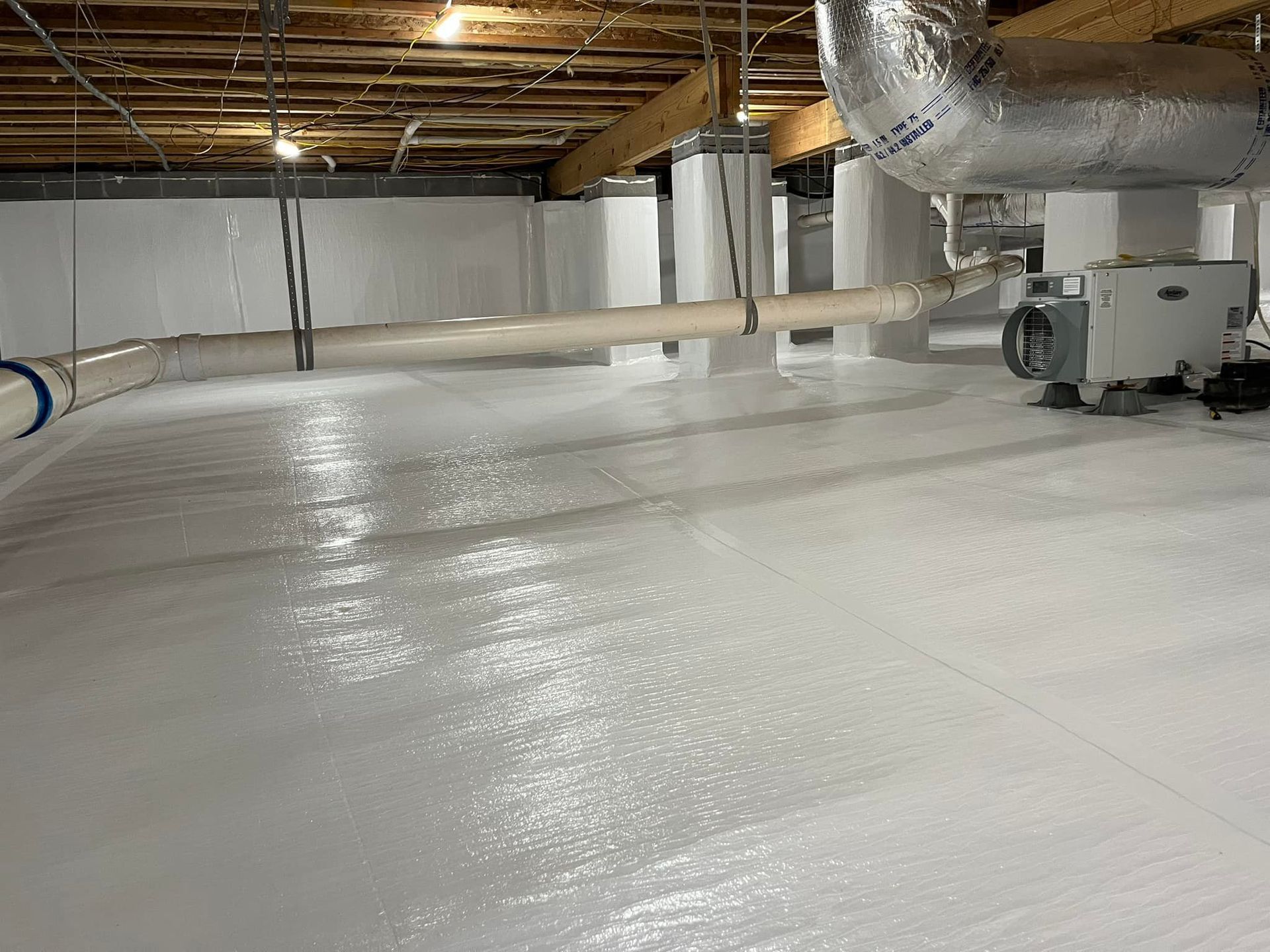
A heavy 20-mil fiberglass-reinforced liner — not the thin plastic sheeting from a hardware store — covers the floor and walls, mechanically fastened and sealed at every seam so ground moisture stays out.
03
Dehumidifier Installed
Then a dehumidifier is installed to actively manage what remains. That last piece matters more in Central Illinois than most places — summer dew points push into the upper 60s and 70s for months.
04
What You'll Notice
Humidity drops, musty odors disappear, floors feel more stable, and the floor framing stops cycling through the wet-dry conditions that degrade wood over time.
About those vents
A lot of Champaign homeowners have been told to open their vents in summer to let the crawl space breathe. Building science has moved past that. In Central Illinois there are maybe six days a year where outside air is dry enough that open vents help rather than hurt. The rest of the year you're pulling humid air directly under your home. We seal those vents on every job.
What we turn up
What Crawl Space Moisture is Doing to Your Bloomington Home
What brought someone to the phone is usually a symptom of something broader. That's why we look at everything — not just the thing you called about.
Floor Joists Soften, Subfloor Gives
You notice a bounce in the floor, a soft spot in the kitchen, a door that doesn't quite close the way it used to. That's not a flooring problem — that's what years of unchecked moisture looks like from below. It's also the most solvable problem on this list.
It Shows Up on Your Energy Bill
An unsealed crawl space is essentially a hole in your home's thermal envelope. You're conditioning the air in your living space and losing a significant portion of it straight down through the floor — every month, on every bill.
The Warning Signs in a Cheap Quote
6-mil poly instead of 20-mil fiberglass-reinforced liner. Liner stapled to the sill plate instead of mechanically fastened. Seams left untaped — which just means gaps that let vapor through. A dehumidifier that's too small or can't drain right. We've gone behind that work more than once. It costs the homeowner twice.
Radon, Plumbing, and HVAC — Planned Around, Not Over
Central Illinois sits in a moderate-to-high radon risk zone, so encapsulation gets planned with that in mind from the start. And everything stays accessible — the liner goes around your plumbing, electrical, and HVAC equipment, not over it. Tell us about any access points that matter to you during the assessment.
This is why the inspection comes first. All of it.
Our walkthrough
How Crawl Space Encapsulation Works - Our Process
Here's what we actually do, in the order we do it.
01
The Old Insulation Comes Out First
If it's sagging or holding moisture - and in most older Bloomington homes it is- it has to go before anything else happens. Sealing around a problem doesn't solve it.
02
Every Vent Gets Sealed
This is the one that surprises people. Crawl space vents are only useful on a low-humidity, high-wind day. In central Illinois, that's about six days a year. The other 359 days, open vents are letting in exactly what you're trying to keep out. We seal every one - airtight, rodent-proof.
03
Rim Joists Get Closed-Cell Spray Foam
Closed-cell spray foam on every rim joist. This stops conditioned air from leaving your house in winter and outdoor air from getting in year-round. It's not optional.
04
The Liner - Floor and Walls
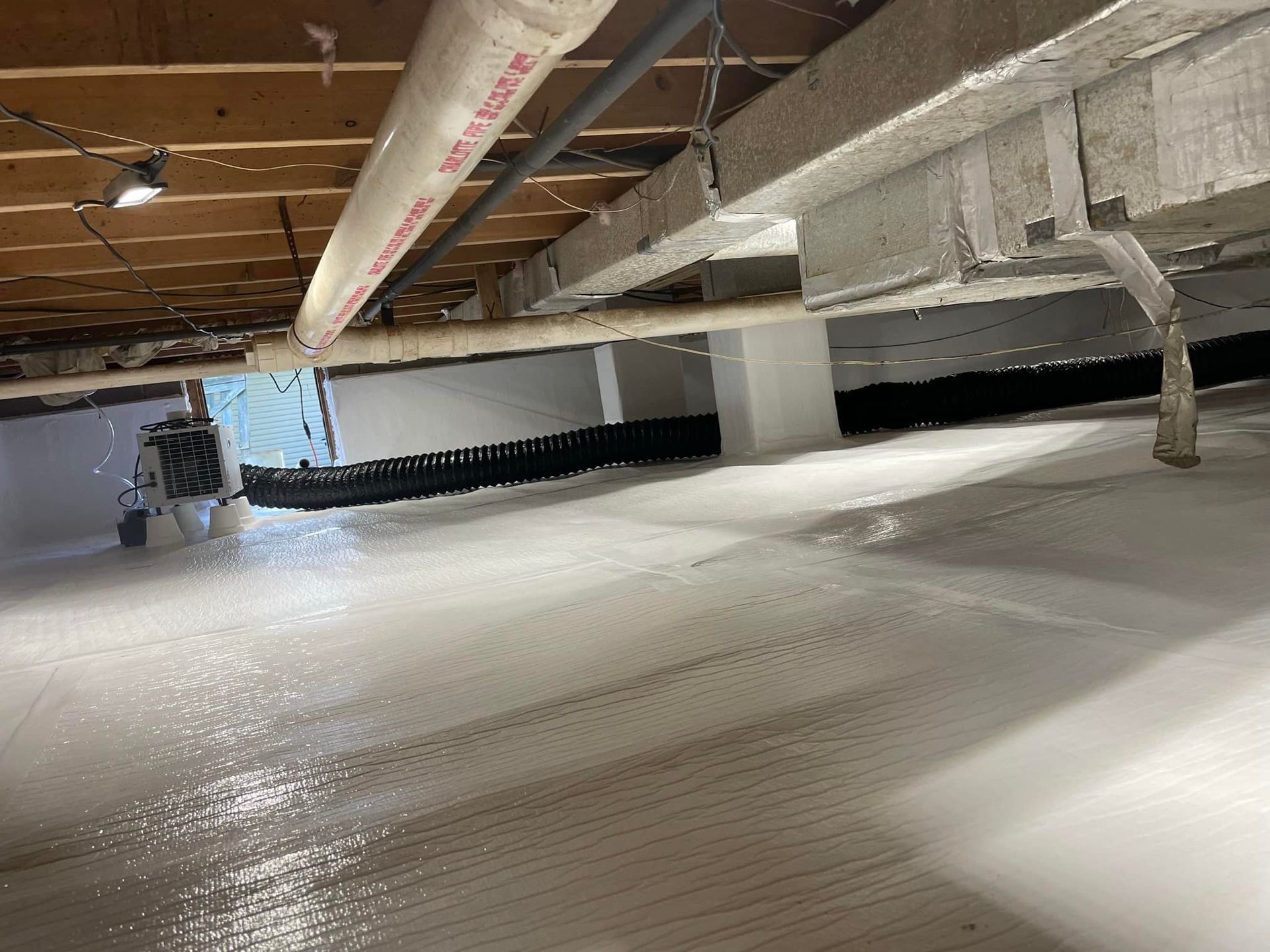
We use 20-mil fiberglass-reinforced polyethylene. Not 6-mil poly. The liner runs up the walls and gets mechanically fastened - not stapled to the sill plate, which pulls loose. Seams are taped. Piers get wrapped. The goal is a continuous sealed barrier with no gaps.
05
Water Intrusion Gets Addressed Before the Barrier
If there's active water getting into the space, that means a crawl drain system along the perimeter, a sump pump, or both - before the vapor barrier goes down. You don't seal a water problem in. We solve it first.
06
The Dehumidifier Gets Sized and Mounted Correctly
This matters more than most people realize. A dehumidifier that's too small for the space can't keep up. One that's mounted wrong and can't drain properly creates the moisture problem it was installed to solve. We get this right.
Questions & Answers
Crawl Space Encapsulation FAQs — Bloomington, IL Homeowners
Should Crawl Space Vents Stay Open or Sealed?
No. Crawl space vents belong sealed. In central Illinois, the conditions where open vents actually help- low humidity, high wind - happen a handful of days per year. Every other day, open vents are letting in moisture, cold air, pests, and dust. We seal every vent on every job.
Can You Still Access Plumbing and HVAC After Crawl Space Encapsulation?
Everything stays accessible. The liner is installed around your plumbing, electrical, and HVAC equipment - not over it. If there are specific access points that matter to you, we design around them. Tell us during the assessment.
How Does Crawl Space Encapsulation Interact With Radon Mitigation?
Central Illinois is in a moderate-to-high radon risk zone. Encapsulation and radon mitigation can work well together- but the encapsulation needs to be planned with that in mind from the beginning. If you have an existing radon system, or think you might want one, tell us before we start. It changes how certain parts of the job get done.
How Long Does Crawl Space Encapsulation Take in Bloomington?
Most residential jobs in Bloomington run one to three days. If drainage work is needed first, that adds time. We'll give you an accurate timeline after the inspection- not before, because we don't guess.
Will Crawl Space Encapsulation Help With Musty Smells and Allergy Symptoms?
Yes. Sealing the source stops the air coming up through your floors. Most homeowners notice a difference quickly.
What Does Crawl Space Encapsulation Cost in Bloomington, IL?
Most jobs in the Bloomington area run between $5,000 and $15,000 depending on the size of the space and what we find. The free assessment gives you an exact number for your specific situation.
Still have questions?
Every crawl space is different. Call us or book a free inspection and we'll walk you through exactly what your home needs.
The next step
Get a Free Crawl Space Assessment in Bloomington, IL
Find out what's going on under your house. Free assessment, no pressure — Jeff or Chris will walk your crawl space, tell you exactly what we find, and give you a written proposal the same day.
Email US