A Real Crawl Space Encapsulation Job in Central Illinois: Here's What We're Doing
When a homeowner finally makes the call, something shifts.
We come out and do a thorough inspection. We get under the home and look at everything — and we show you what we're seeing in real time so there are no surprises when we sit back down with you. You'll know exactly what's down there. You'll know exactly what it takes to fix it. And you'll have a clear picture of what your home looks like after the work is done.
No pressure. No scare tactics. Just an honest look at what's happening and a straightforward plan to address it.
Most homeowners tell us the same thing after that first visit.
They wish they hadn't waited as long as they did.
A Full Crawl Space Encapsulation, Start to Finish
We're over in Urbana today running a full crawl space encapsulation. Sump pump swap, wall liner, vapor barrier on the floors, spray foam on the rim joist, and a dehumidifier going in before we leave.
Most homeowners never see what actually happens during one of these jobs. You get a quote, you sign off, and a crew shows up. Then a few hours later somebody knocks on your door and says it's done.
But there's a lot that happens between those two moments. And understanding what should be happening—and in what order—is the difference between knowing you got a complete solution and just hoping you did.
That's why we're walking you through this one from start to finish.
Meet the Crew
Jackson's out today, so we've got Dennis, Dylan, Alex, and Ryan on site.
People sometimes assume "owner-operated" means it's just Chris and me doing everything ourselves. It doesn't. What it means is that we're accountable for every person we put in your home. We train them, we trust them, and we stand behind their work the same way we stand behind our own.
Dennis is working through the rim joist spray foam right now. Dylan, Alex, and Ryan are handling the liner installation. Everyone has a role, everyone knows what they're doing, and the job moves efficiently because of it.
When you hire a big company, you get whoever shows up that day. When you hire My Guys, you get a team we've personally put together and vouched for. That matters more than most people realize.
Step One: The Sump Pump Swap
First thing we took care of on this job was the sump pump.
A sump pump sits in a pit at the lowest point of your crawl space. When water finds its way in—whether from rain, groundwater, or poor drainage—the pump collects it and moves it out through a discharge line to the outside of your home.
On this job we swapped out the existing unit using the current discharge line. No major rerouting needed, just a proper replacement with a unit we trust.
Here's why this matters: a sump pump is your last line of defense against standing water. If it fails, everything else in your crawl space takes the hit. Your vapor barrier, your liner, your floor framing—all of it suffers when water has nowhere to go.
A lot of encapsulation quotes don't include the sump pump. They'll seal everything up beautifully and leave an aging pump in the pit that's one heavy rain away from failing. That's not a complete solution. It's a problem waiting to happen.
Step Two: Sealing the Walls and Floors
With the sump handled, the crew moved into the liner installation.
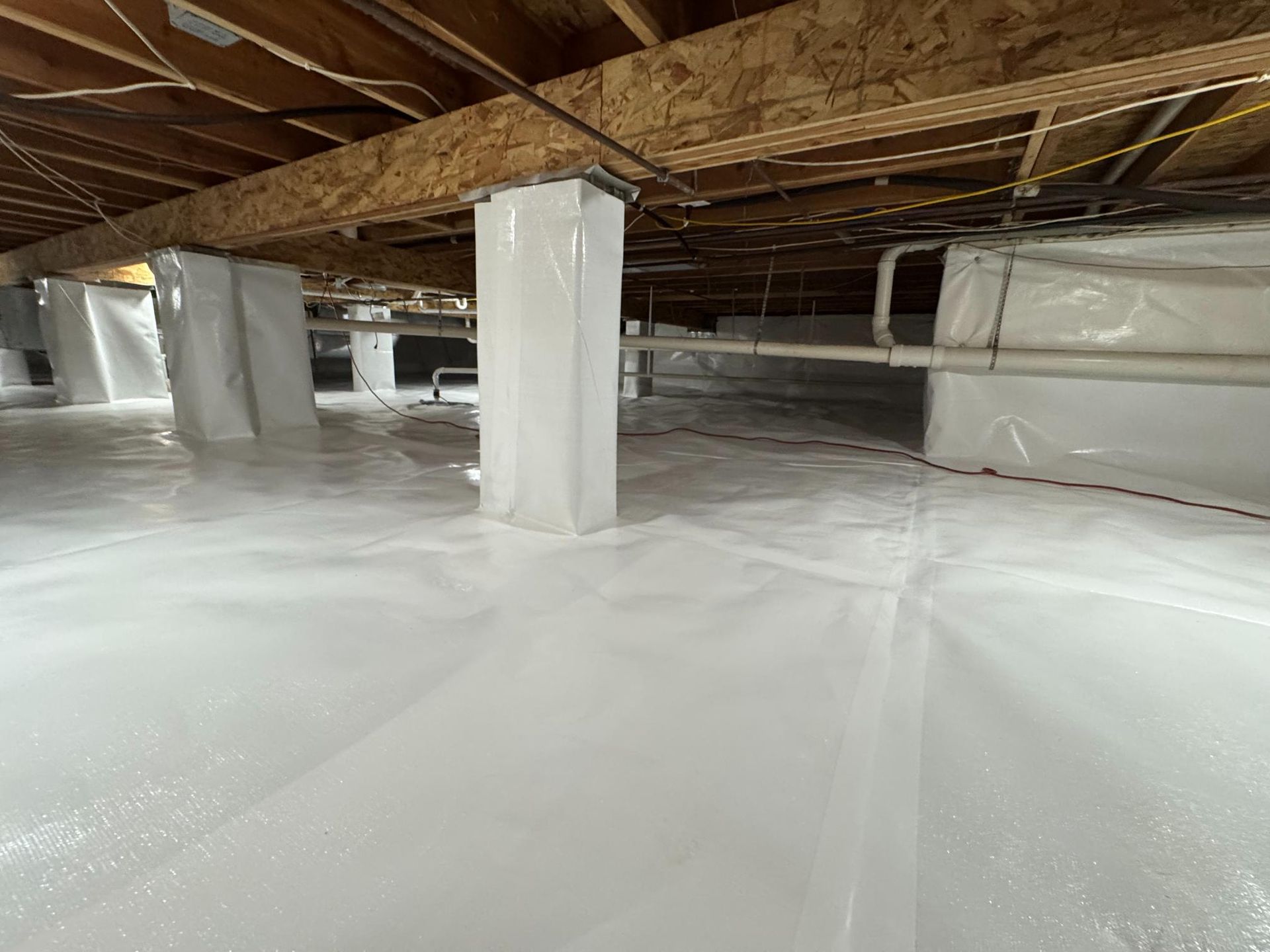
This is the part most people picture when they hear "crawl space encapsulation." White liner going up on the walls, vapor barrier going down across the dirt floors. And while it's the most visible part of the job, it's only as good as how it's installed.
The floor vapor barrier stops ground moisture from rising up into your crawl space. The ground is always releasing moisture, even when it looks dry. Without a proper barrier, that moisture works its way up into your floor framing, your insulation, and eventually into the air you're breathing upstairs.
The wall liner seals your foundation walls. Concrete and block walls are not waterproof. They absorb moisture and release it into the crawl space air. The liner stops that process and creates a continuous sealed environment.
What separates a good installation from a bad one is in the details. Are the seams properly overlapped and taped? Is the liner running up the wall and sealed at the top? Is it tucked and secured at the base? These things don't take much longer to do right, but they make an enormous difference in how well the system performs over time.
Shortcuts here are easy to hide. Which is exactly why we document everything with photos and video before we're done.
Step Three: Spray Foaming the Rim Joist
This is the step a lot of contractors leave out entirely.
The rim joist runs along the top of your foundation wall where it meets your floor framing. It's essentially the border between your crawl space and the outside world. And in most homes, it's full of gaps.
Those gaps let in cold air in the winter, warm humid air in the summer, and bugs and pests year round. If your floors feel cold even with the heat running, there's a good chance your rim joist is uninsulated or improperly sealed.
Spray foam fills every gap and creates an airtight seal. It expands into the irregular surfaces that rigid insulation can't cover, which means no cold spots and no air infiltration. Once it's in, it's in for good.
Dennis is working through that today, section by section around the perimeter of the crawl space.
Most standard encapsulation quotes don't include this. You'll get the liner and maybe a dehumidifier, but the rim joist gets left as is. Then the homeowner wonders why their floors are still cold or why the humidity levels keep creeping back up.
If you're getting quotes on encapsulation, ask specifically whether rim joist treatment is included. If it's not, ask why. The answer will tell you a lot about how thorough that contractor is planning to be.
Book A Free Inspection Now
Your crawl space problems aren't going to fix themselves. But they are fixable. Let's get it done — the right way, permanently.
Or call us directly (217) 863-9559
Ready to See What's Really Going On Under Your Home?
If you've got moisture issues, musty smells, cold floors, or you just want to know what's actually happening in your crawl space, reach out to us.
Chris or I will come out personally, do a thorough inspection, and show you exactly what we find. We document everything with photos and video so you understand what's going on before we ever talk about solutions.
No pressure. Just honest answers from people who actually live and work right here in Central Illinois.