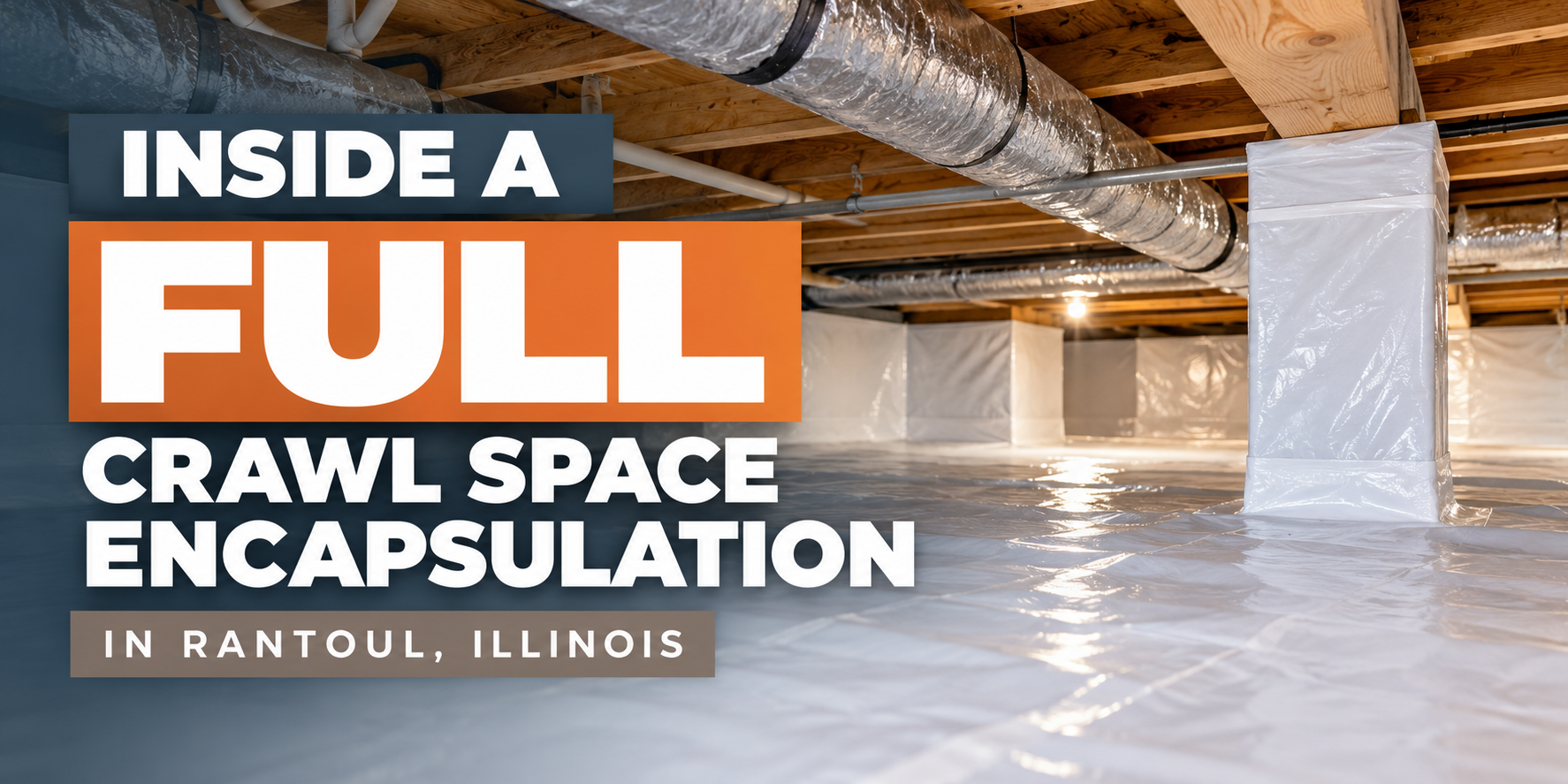
Inside a Completed Crawl Space Encapsulation in Mahomet
What a Finished Job Actually Looks Like
Jackson just finished up a full crawl space encapsulation here in Mahomet, and I wanted to show you what the finished product actually looks like.
Most homeowners never see a completed crawl space. The crew says it's done, you write the check, and you trust they did what they said they'd do. But unless you crawl down there yourself—and let's be honest, most people aren't doing that—you're taking their word for it.
So here's a walkthrough of what "finished" actually means. Not just sealed up and called good, but a complete system that's going to protect your home for years.
When we say the job's done, this is the standard we're talking about.
The Vapor Barrier: Clean and Properly Installed
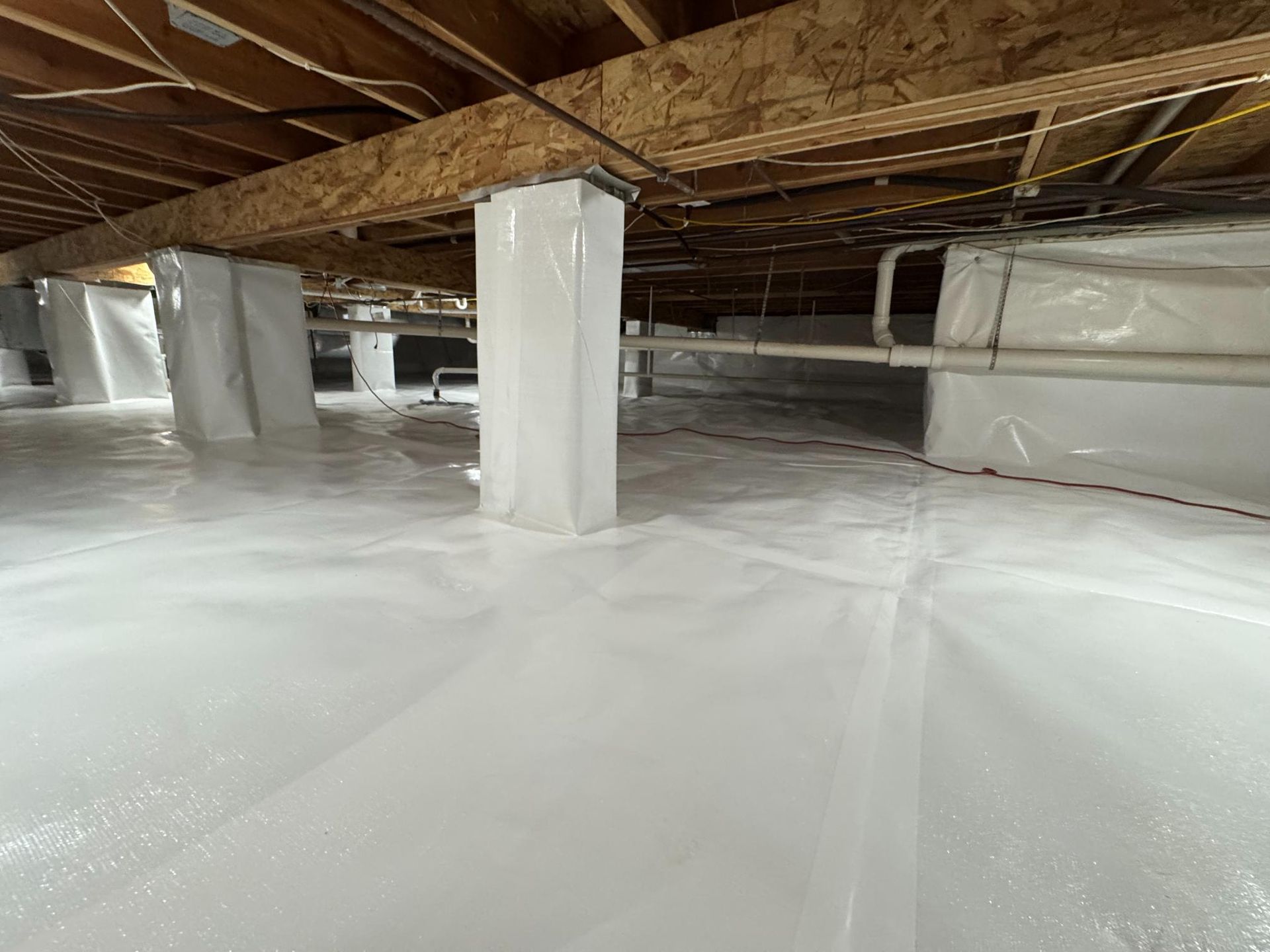
First thing you'll notice: the vapor barrier is bright white and clean. Not wrinkled up in corners, not bunched around obstacles, not just "close enough." It's properly installed throughout the entire space.
The seams are sealed. It's attached correctly at the foundation walls. There's complete coverage—no exposed dirt, no gaps where moisture can still come up from the ground.
This matters because the vapor barrier is your first line of defense against ground moisture. If it's not installed right, it's not doing its job. We've seen plenty of crawl spaces where someone just rolled out some plastic and called it a day. Gaps everywhere. Seams not sealed. Plastic pulling away from the walls after a few months.
That's not encapsulation. That's just covering up the problem temporarily.
A properly installed vapor barrier looks clean because it was done with care. It'll still look like this in five years because it was installed to last. That's the difference between a crew that's rushing to the next job and one that's actually finishing this one.
The Dehumidifier: Active Humidity Control
Here's something a lot of companies won't tell you: sealing your crawl space is only half the job.
You can install the best vapor barrier in the world, seal every vent, and make it airtight. But if you don't control the humidity that's already in that air, you're going to have problems. Mold. Musty smells. That damp feeling that never quite goes away.
That's why we install a dehumidifier as part of every encapsulation. Not as an upsell or an optional add-on—as a necessary part of the system.
The dehumidifier we installed here is properly sized for this space and positioned where it'll work most effectively. It's going to keep humidity levels where they need to be year-round. That protects your floor joists, keeps mold from growing, and improves the air quality in your whole house.
Remember: about 50% of the air you breathe upstairs comes from your crawl space. If that air is humid and musty, that's what you're breathing. The dehumidifier isn't just protecting your wood and insulation—it's protecting your family's health.
Some companies will seal your crawl space and skip this step entirely. They'll tell you the vapor barrier is enough. It's not. Without active humidity control, you're just creating a sealed box with moisture trapped inside. That's actually worse than leaving it alone.
A complete encapsulation includes humidity management. Always.
Drain Tile and Sump Pit Relocation
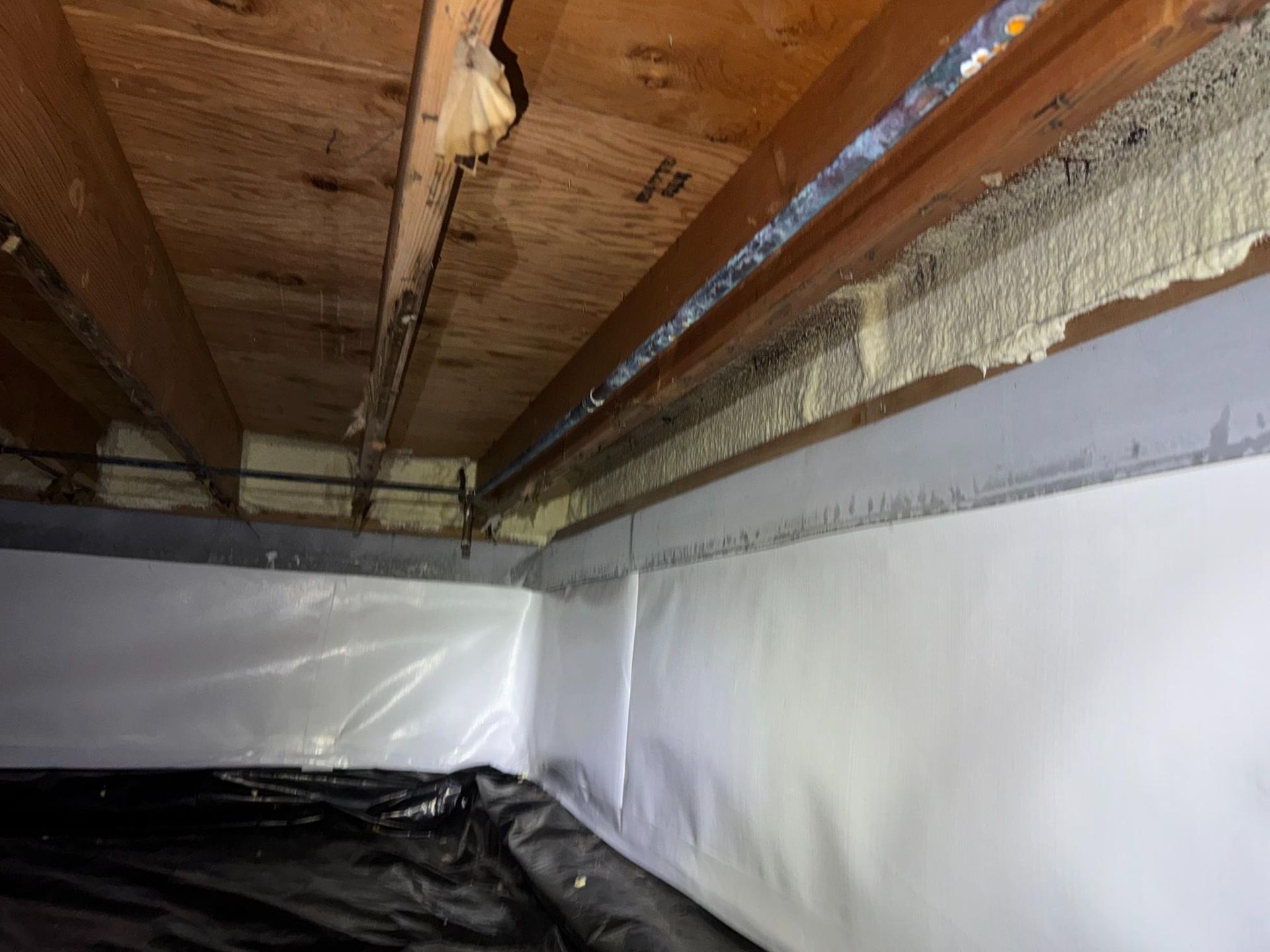
On this job, we relocated the sump pit from the main crawl space entrance to a better location. Then we ran drain tile along the perimeter of the house to direct water to that new spot.
Most people wouldn't think twice about where the sump pit goes. But placement matters. A lot.
Water builds up pressure against your foundation from the outside. That's just how groundwater works. If your drainage system isn't positioned to catch that water where the pressure is highest, it's not doing its job efficiently.
We ran the drain tile along the perimeter because that's where water tries to come in. The tile captures it, directs it to the sump pit, and the pump removes it from under your house before it ever becomes a problem. It's a system designed to handle water at every stage.
Could we have left the sump pit where it was and called it good? Sure. The job would've been "done." But it wouldn't have been done right.
These kinds of decisions—where to place the pit, how to route the drain tile, making sure everything slopes correctly—these are what separate a crew that's just checking boxes from one that's actually solving your water problem long-term.
You're not going to see this level of detail in a sales pitch or on a quote. But you'll see the results for the next 20 years.
How These Components Work Together
Here's what makes this a system instead of just a collection of parts:
The vapor barrier blocks moisture coming up from the ground. The dehumidifier controls the humidity in the air. The drain tile captures water trying to come in from outside. The sump pit removes that water from under your house.
Each one handles a different part of the moisture problem. And when they're all working together, your crawl space stays dry. Your floors stay stable. Your air stays clean.
But if even one piece is missing or done poorly, the whole thing doesn't work the way it should. An undersized dehumidifier can't keep up. Drain tile in the wrong spot doesn't catch the water. A vapor barrier with gaps lets moisture through.
That's why we don't skip steps. That's why we don't cut corners on placement or sizing or installation quality. Every component matters.
When Jackson walks a customer through a finished job like this, they can see that everything was done completely. Not just the parts that are easy to check, but the whole system working together the way it's supposed to.
What You Should See When Your Job Is Done
When your encapsulation is finished, here's what you should be looking at:
A clean, bright crawl space you could actually walk through without stepping on debris or tripping over leftover materials. All the components installed and working—dehumidifier running, sump pump tested, vapor barrier sealed properly.
Lighting throughout the space so you or the next contractor can actually see what's down there. No dark corners, no "you'll need a flashlight for that section."
And your contractor should want to show you all of this. They should invite you down there for a walkthrough, or at minimum, provide detailed photos and video of the finished work.
Red flags? A crew that rushes through the final walkthrough. A contractor who discourages you from inspecting the space. Anyone who says "you don't need to see it, just trust us."
Good work looks good. If they did the job right, they'll be proud to show you. If they're trying to get out of there fast and collect payment, that tells you something too.
You paid for a complete system. You should be able to see that you got one.
The Mahomet Standard
Chris and I live here in Mahomet. We've been here our whole lives. When we finish a job like this, we're not disappearing to some corporate office three states away.
We're right here. We'll see this customer around town. Our reputation isn't abstract—it's personal.
That's why we hold ourselves to this standard. This isn't us going above and beyond. This is just what a complete encapsulation should look like. Every time.
The vapor barrier properly installed. The dehumidifier sized and placed correctly. The drainage system designed for this specific home. The whole space clean and functional when we're done.
We keep our team small on purpose. It means Chris or I can be on every job. It means we can control the quality. It means when we say it's done right, we can back that up.
This is the work we're willing to put our names on.
Book A Free Inspection Now
Your crawl space problems aren't going to fix themselves. But they are fixable. Let's get it done — the right way, permanently.
Or call us directly (217) 863-9559
Ready to See Your Crawl Space Transformed?
If you're dealing with crawl space moisture, musty smells, or you just want to know what's actually happening under your house, give us a call.
We'll do a thorough inspection and show you exactly what we find. No pressure, no gimmicks. Just an honest assessment of what your crawl space needs.
And if we do the work, it'll look like what you just saw—complete, clean, and built to last.
Reach out anytime. We're here in Mahomet, and we're ready to help.