Why Sealing Just the Floor Doesn't Solve Your Moisture Problem
The Floor Is Just One Part of the Problem
I'm standing in a 15,000 square foot crawl space under an apartment complex in Champaign. Two buildings, 30+ families living above this space. And I keep getting asked the same question: "Why can't you just throw a vapor barrier on the floor and call it good?"
Here's the short answer: because the floor is only one of five places moisture enters your crawl space.
A vapor barrier on the ground stops ground moisture. That's it. But water is still coming through your foundation walls. It's still wicking up through your support piers. It's still entering through unsealed rim joist pockets. And humidity is still flowing in through open vents.
Floor-only encapsulation solves maybe 20% of your moisture problem. The other 80%? Still there, still causing damage, still affecting your air quality.
Let me show you what a real encapsulation actually includes—and why it matters.
The Five Moisture Sources Most Contractors Ignore
Moisture doesn't just come up from the ground. It attacks your crawl space from five different directions:
Ground moisture seepage. This is the one everyone knows about. Water in the soil works its way up and creates humidity in your crawl space. A floor vapor barrier helps with this—but only this.
Water penetrating through foundation walls. Your foundation is concrete block, which is porous. When you've got wet soil sitting against the outside of that wall, water slowly makes its way through those pores into your crawl space. You'll see it as efflorescence—that white, chalky stuff on the walls.
Moisture wicking up through support piers. Those concrete piers holding up your floor joists? They're sitting on the ground, and moisture travels up through the concrete like a sponge.
Air and humidity entering through rim joist pockets. Where your foundation meets your floor framing, there are gaps. Unsealed, those gaps let in outside air, humidity, and everything that comes with it.
Exterior humidity through open vents. A lot of crawl spaces still have foundation vents that stay open. In summer, you're pulling hot, humid air directly into the space.
When you only put plastic on the floor, you're addressing one source. The other four? Still active, still creating moisture, still causing problems. And here's the kicker: sometimes a partial solution makes things worse.
What Happens When You Only Seal the Floor
Here's what a lot of homeowners don't realize: when you seal just the floor but leave the walls, piers, and rim joists open, you're not solving the problem. You're trapping it.
Moisture is still coming in through those foundation walls. Still wicking up the piers. Still entering through rim joist pockets. But now it has nowhere to go. So where does it end up? Condensing on your floor joists, your subfloor, your support beams.
That creates the perfect conditions for mold, mildew, and wood rot. Sometimes even worse than if you'd done nothing at all, because at least before, that moisture could move around and eventually dry out. Now it's trapped against your wood framing.
I've seen crawl spaces where someone paid good money for a "vapor barrier," and three years later the floor joists are rotting because moisture from the walls had nowhere to go but up.
You can't shortcut physics. If water is entering your crawl space from multiple directions and you only block one of them, the problem doesn't go away. It just moves.
This is why those budget encapsulation quotes that seem too good to be true usually are. They're selling you a floor vapor barrier and calling it encapsulation. And in a few years, you'll be paying someone else to come fix the damage that partial solution caused.
What a True Encapsulation Actually Includes
So what does a real encapsulation look like? Let me walk you through what we're doing on this commercial job—same process we use on residential homes, just bigger scale.
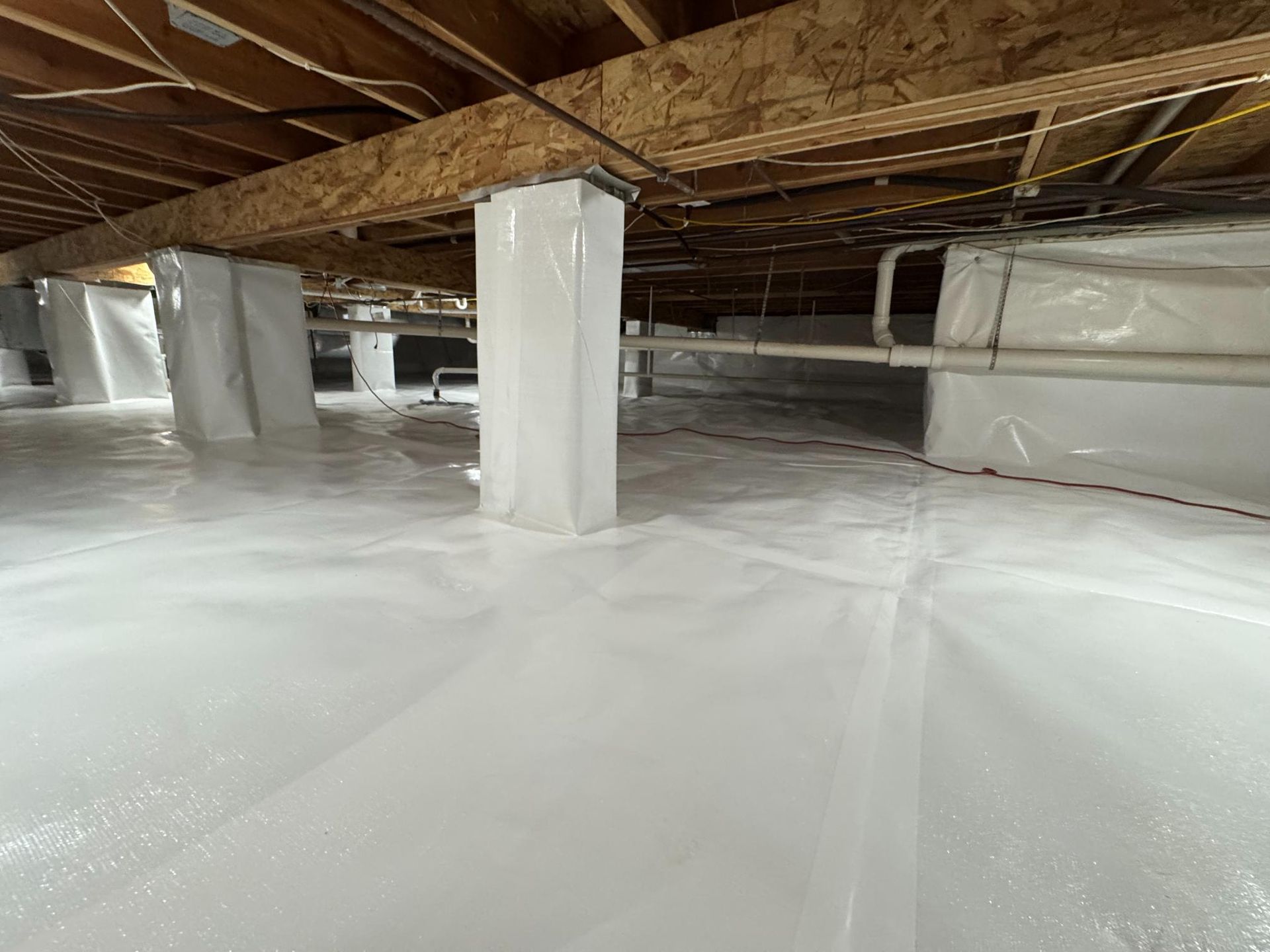
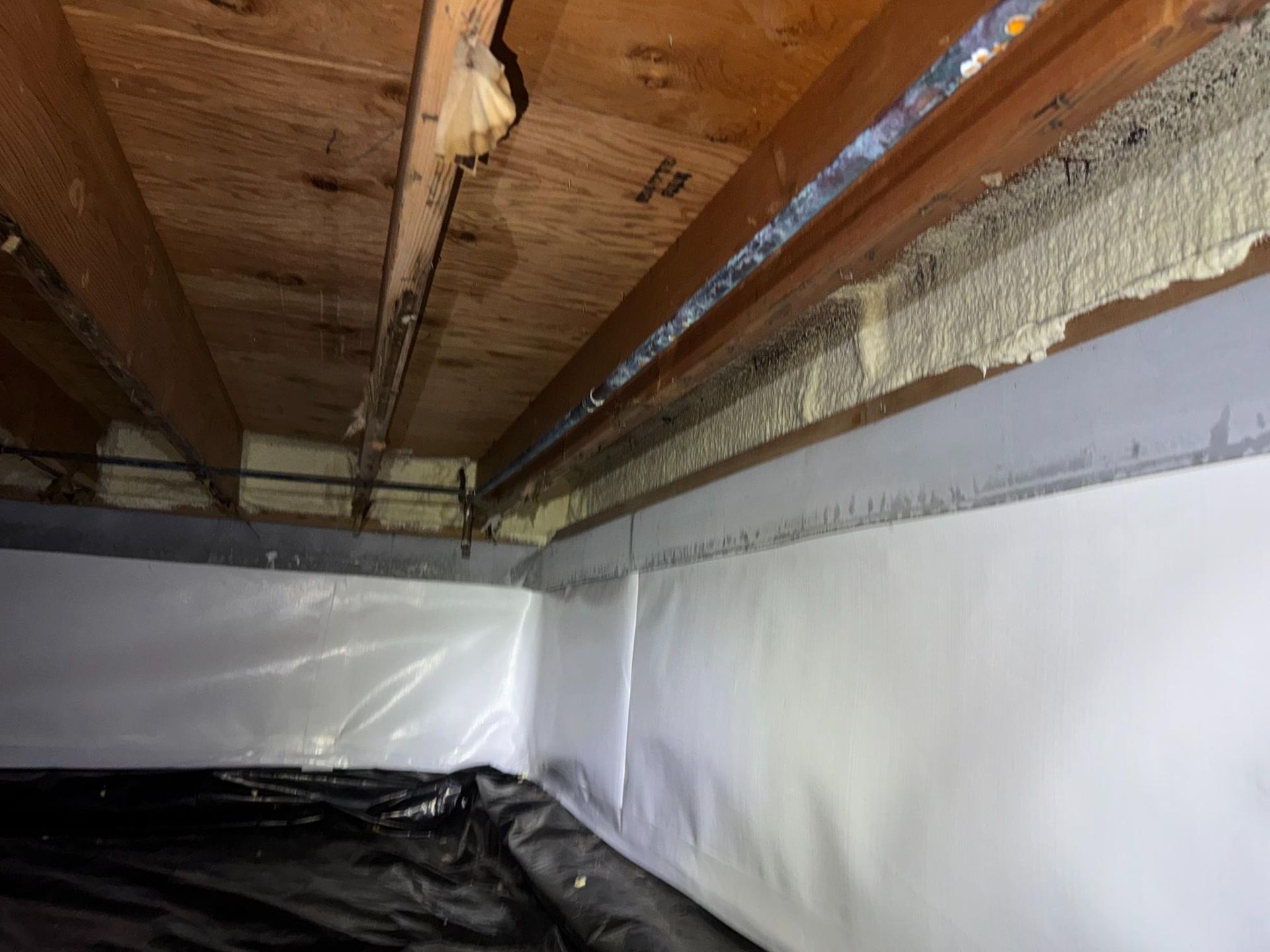
Vapor barrier on the floor and up the walls. Not just lying on the ground. We bring that barrier up the foundation wall, usually 6-8 inches below the sill plate. This stops ground moisture and water coming through the walls.
Mechanical fastening. We don't just tuck the barrier and hope it stays. We use mechanical pins every few feet to hold it against the wall permanently. Otherwise, gravity and humidity will pull it down over time.
Butyl tape seal at the top. Along the top edge where the wall barrier meets the rim joist, we run a bead of butyl tape. Creates an airtight seal so moisture can't sneak up and out.
All piers wrapped. Every single support pier gets wrapped with vapor barrier. Stops moisture from wicking up through the concrete into your crawl space air.
Closed-cell spray foam in every rim joist pocket. This is the part a lot of companies skip because it's labor-intensive. But those rim joist pockets are major air infiltration points. We seal every single one with spray foam. Stops air, stops humidity, improves energy efficiency.
All vents sealed. No point controlling moisture inside if you're pulling humid outside air in through foundation vents.
Whole-space dehumidification. Even with everything sealed, you need active moisture control. We install commercial-grade dehumidifiers sized for the space. This job is getting three of them for 15,000 square feet.
When we're done, this isn't just "plastic on the floor." It's a controlled environment. Clean, dry, bright, and protected from all five moisture sources.
Why the Walls and Rim Joists Matter So Much
The walls and rim joists are where most contractors cut corners, and they're exactly where the problems start.
Your foundation walls are concrete block. That material is porous—it has tiny holes throughout. When wet soil sits against the outside and you've got open block on the inside, water moves through. You'll see it as that white chalky residue on the walls. That's efflorescence—mineral deposits left behind as water evaporates. It means moisture is actively coming through.
If you don't seal those walls, that moisture is entering your crawl space every single day.
Rim joist pockets are just as bad. That's where your foundation meets your floor framing, and there are gaps everywhere. Unsealed, those gaps create what's called the stack effect—air moving from your crawl space up into your living space. Humid crawl space air goes straight into your home.
Sealing the rim joists isn't optional. It's not the "cherry on top." It's essential for controlling moisture and improving energy efficiency.
When we seal walls and rim joists, we're not upselling. We're finishing the job properly.
The Air Quality Connection
Here's something that matters whether you're a homeowner or managing an apartment building: about 50% of the air you breathe on your first floor comes from your crawl space.
That's not a maybe. That's how air movement works in homes. Air enters through the crawl space and rises up into your living area through gaps in the subfloor, around pipes, through ductwork.
So if your crawl space has high humidity because moisture is coming through unsealed walls and rim joists, that's the air you're breathing upstairs. Mold spores, mildew, dust mites—they all thrive in humid environments.
A floor-only vapor barrier doesn't stop wall moisture. Doesn't stop rim joist infiltration. Which means it doesn't stop the humidity that's affecting your indoor air quality.
On this commercial job, we're protecting 30+ families across two buildings. Every single one of them deserves clean air and a healthy home. That's why we're sealing everything—walls, piers, rim joists, the whole system.
Because crawl space moisture isn't just a structural issue. It's a health issue. And it affects everyone living above that space.
How to Know If You're Getting Real Encapsulation
If you're getting quotes for crawl space work, here are some questions to ask:
Does the proposal include sealing the walls, or just the floor?
Are they mechanically fastening the vapor barrier, or just laying it down?
What about the rim joist pockets—are those being sealed with spray foam?
Is dehumidification included, or is that an "optional upgrade"?
Will they wrap the support piers?
Can they show you photos of completed work that includes all these elements?
Red flags: any contractor who says "we'll just throw some plastic down" or "you don't need all that extra stuff." You do. That "extra stuff" is what actually solves the problem.
A real encapsulation quote will be more expensive than a floor-only barrier. That's because there's significantly more labor and materials involved. But it's also the difference between a solution that works and one that leaves you with ongoing moisture issues.
Ask for detailed documentation. Before photos, after photos, and clear explanations of what's included. Good contractors will gladly show you their process.
Book A Free Inspection Now
Your crawl space problems aren't going to fix themselves. But they are fixable. Let's get it done — the right way, permanently.
Or call us directly (217) 863-9559
Get a Real Assessment, Not a Sales Pitch
If you're dealing with crawl space moisture, musty smells, or you're just trying to understand what's actually happening under your home, we can help.
We'll come out, do a thorough inspection, and show you exactly what we find. We'll explain all five moisture sources in your specific crawl space and what a complete solution looks like.
No pressure, no gimmicks. Just Chris or me walking you through your options.
Reach out anytime. We're here in Mahomet, serving Central Illinois.
My Guys Home Services